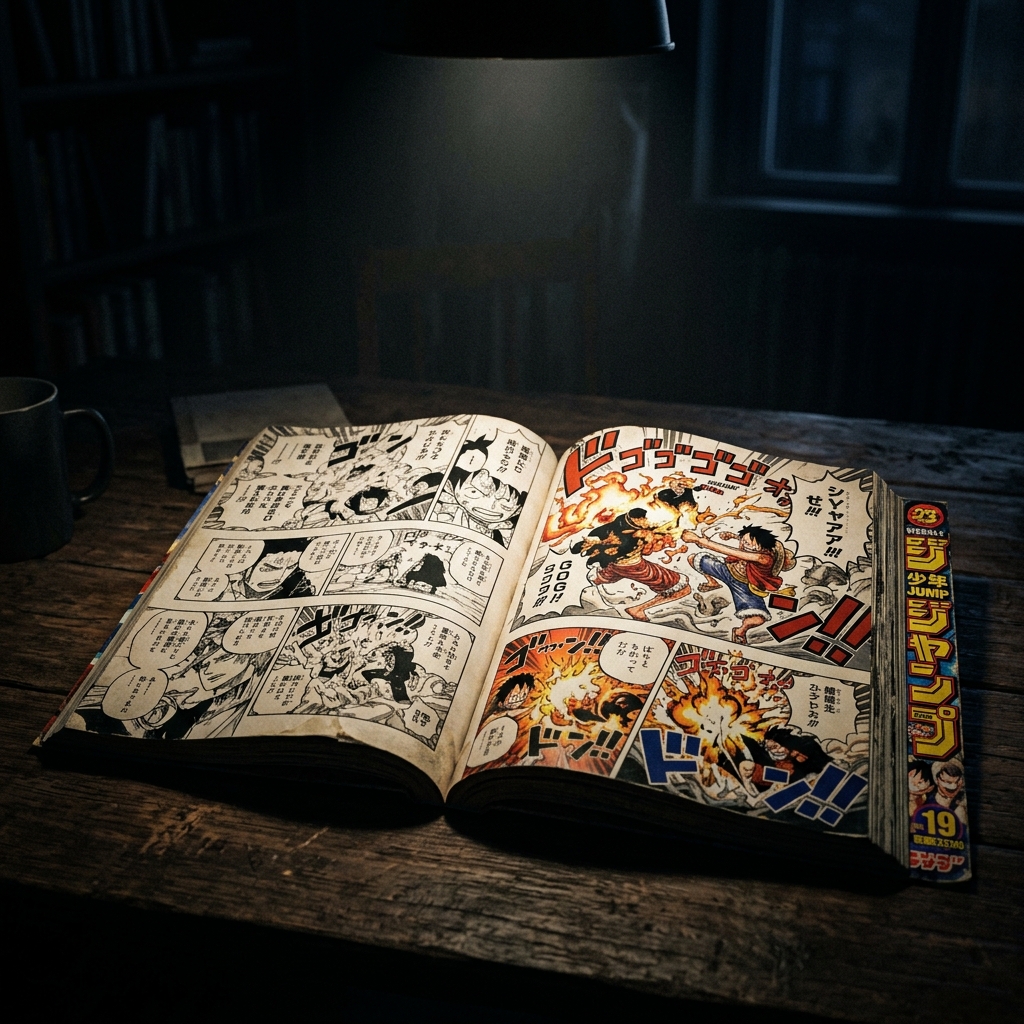
Every fandom has its own version of a certain conversation. In manga and anime fandoms, that conversation is almost always power scaling. It is the practice of ranking characters by how strong they are and then arguing, at length, about whether Character A could defeat Character B in a fight neither of them will ever actually have.
The most common format is a forty-minute YouTube video that speaks in the cadence of a legal argument. Evidence is presented. Counterarguments are preemptively addressed. A verdict is rendered with more confidence than most courtroom decisions. I find these videos tedious and I watch them when I cannot sleep, which happens more often than I would like to admit. Both of those things are true simultaneously.
The tedious part is methodological. Power scaling treats combat in manga as a points system where every fight reveals fixed numbers and those numbers transfer predictably across different matchups. Manga does not work that way. Outcomes are determined by what the author needs to happen for the story to proceed, not by a consistent internal logic the author is faithfully executing. When Yoshihiro Togashi has a character in Hunter x Hunter do something that appears inconsistent with their established strength level, the power scaling community treats this as an error to correct. Togashi almost certainly did not make an arithmetic mistake. He made a story decision.
Akira Toriyama said in an interview that Dragon Ball power progression was not systematically designed. He was making it up as the story required, escalating when escalation felt right, not tracking numbers in a spreadsheet. The power scaling community has spent roughly thirty years trying to reverse-engineer a coherent system from material that was never meant to have one. There is something almost admirable about the stubbornness of that project. Something a little poignant too, if you are in the right mood.
The appeal, when I am being fair about it, is pattern recognition. People like building models and testing them. They like puzzles. Power scaling is a puzzle hobby that uses manga as its dataset, and the quality of analysis within that hobby ranges from genuinely creative to impressively circular. The videos I end up watching at 2 AM are the ones where the creator is clearly enjoying the thought experiment without pretending it is more than that. Those are actually fun. The serious ones, where someone spends twenty minutes establishing that one character is 47.3 times stronger than another based on blast radius calculations from a panel in volume 12, are harder to sit with.
What I notice is that the series attracting the most intensive analysis are almost always the ones built explicitly around power progression. Dragon Ball, My Hero Academia in its earlier volumes, Naruto during the chunin exams. Series where power is deliberately left vague or where fights are about something other than relative strength attract much less attention. Nobody builds a ranking system for Vagabond because Vagabond fights are about fear and exhaustion and the specific way a skilled person still sometimes makes catastrophic mistakes. The subject matter resists the genre.
If you are new to manga communities and you encounter power scaling discourse: it is a separate hobby that some readers have. You can find a series interesting without ever thinking about how its characters would rank against characters from a different series. The fights in most of the good manga are not actually the reason the stories are worth reading anyway.